Augmented Form
Definition
The augmented form of the course's initial LP models replaces each functional constraint by an equality with a nonnegative slack variable. For , , this gives
with the same objective in the original variables.
Interpretation
The augmented form rewrites each constraint as an equation by giving the unused amount a name, the slack variable. Adding slacks changes the algebraic representation, not the allowed original decisions: each feasible choice of the original variables determines exactly one value of every slack.
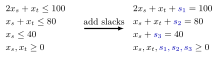
The figure applies this to the three constraints of the Giapetto model: every row gets its own slack, and the slacks receive the same nonnegativity requirement as and . At the production plan , for example, the slacks are , and : finishing and carpentry hours are used up, while the soldier-demand limit has 20 units to spare.
The requirement is what keeps the meaning of the inequality: holds exactly when . Without it, the equation could be satisfied by any and and would restrict nothing. The objective gives every slack coefficient zero, since unused capacity earns nothing.
Equations are what the simplex method needs: it fixes some variables at zero and solves the equations for the others, which gives a basic solution. Constraints of type are turned into equations with a subtracted surplus variable instead, and rows without an obvious starting value then receive an artificial variable.
Key Results
- Auxiliary variables count as variables of the equality system from which a basis is chosen.
- For independent equalities in augmented variables, a basis contains variables.
- Artificial variables used for other constraint types require a feasibility phase; they cannot simply remain free in the final model.
Examples
In the figure, measures unused finishing hours, unused carpentry hours, and unused soldier-demand allowance. The three equations contain five variables, so a basis sets two nonbasic variables to zero.
- Two original variables and two slack variables give four augmented variables.
- The constraints and have initial solution .
Prerequisites
Related Concepts
Sources
- OR Modelling · Week 2
Aliases: slack form
Last updated: 20 October 2026 03:02
Augmented FormArtificial VariableBasic SolutionSlack VariableLinear Programming