Holding Cost
Definition
A holding cost charges for inventory kept in stock. In the continuous-time EOQ model, is the cost per unit held per unit of time. With average inventory , the average holding cost rate is . In the discrete-time models, charges each unit carried from period to .
Interpretation
Holding cost is the price of keeping goods in stock: space, tied-up money, spoilage. Charged per unit and per unit of time, it penalizes large and early orders and pushes batch sizes down.
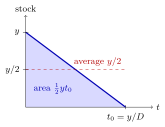
The triangle is one cycle of the sawtooth: stock falls from to in time . Its area adds up stock multiplied by time, and turns it into the holding cost of one cycle, the same as holding the average stock , the dashed line, all the time.
The average stock in the sawtooth is (dashed line), so the holding cost rate is . Raise to see fall.
A common slip is to charge per unit time in the classical EOQ model, as if the whole batch stayed in stock. The time unit of must match that of the demand rate: in the snack-bar Examples, per kilogram per week becomes per kilogram per day.
Key Results
- The shaded triangle has area . Multiplying by gives the holding cost of one cycle, ; dividing by the cycle length gives the cost rate . Thus classical EOQ average inventory is .
- With planned shortages, the full-cycle average positive stock is , not .
- Discrete-time exercises charge end-of-period stock.
Examples
- The snack bar converts 3 per kilogram per week to per kilogram per day.
- The pencil example charges per pencil per day.
Prerequisites
Related Concepts
Sources
- OR Modelling · Week 5
Aliases: carrying cost, inventory holding cost
Last updated: 20 October 2026 03:02
Holding CostClassical EOQ ModelDynamic Lot-Size ModelShortage CostSilver-Meal HeuristicInventory PolicySetup CostEOQ with Planned Shortages