Continuous Newsvendor Rule
Proposition
For continuous demand with finite mean and CDF , the newsvendor expected cost of ordering , with underage cost and overage cost , satisfies
If is continuous and strictly increasing through and that quantile lies in the allowed quantity domain, the unique optimum is
Interpretation
The rule says that the best order is a demand level, not the average demand: order the quantity that demand stays at or below with probability exactly , the critical ratio. Which level is chosen depends on the costs only through .
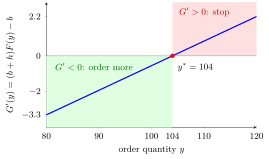
For meal demand uniform on with and , the line rises from at to at . Where it is negative, ordering a little more lowers the expected cost; where it is positive, ordering more raises it. It crosses zero at , where .
Where is zero the CDF equals ; read off the right panel.
The formula for compares the two risks of one extra unit. It is left over with probability , at cost , and is sold with probability , saving ; the net effect is . Because never decreases, never decreases either, so first falls and then rises and a zero of is a global minimum. Strict increase of at makes the zero unique: if stays equal to on a whole interval, every point of that interval is optimal, so continuity alone is not enough. The quantile must also lie in the allowed range of ; a normal quantile can be negative, and then the best order is .
The discrete newsvendor rule makes the same comparison for whole units, with a difference instead of a derivative.
Key Results
- For uniform demand on , the optimum is .
- For the course normal demand approximation , it is , where is the standard normal CDF.
- A continuous demand approximation may give a noninteger answer even when actual items are indivisible.
Examples
- Meal demand uniform on with gives 104 meals.
- Normal meal demand with mean 100 and standard deviation 20 gives about 105.07.
Prerequisites
- Critical Ratio
- Continuous distributions and differentiation
Related Concepts
Sources
- OR Modelling · Week 6
Symbols: beta, mu, phi, sigma
Last updated: 20 October 2026 03:02
Continuous Newsvendor RuleNormal Demand DistributionUniform Demand DistributionWeibull Demand DistributionCritical Ratio