EOQ with Price Breaks
Definition
The course's EOQ model with price breaks gives an all-unit discount: every ordered unit has price when the batch meets a threshold . Following the “at least” convention of the worked examples,
Holding rate is fixed across price levels; demand is constant, replenishment instantaneous, and shortages prohibited.
Interpretation
With an all-unit discount, ordering at least units lowers the price of every unit in the batch. Buying more than the EOQ can then pay off even though it raises the holding cost, so the purchasing cost must be included in the comparison instead of being left out as in the classical EOQ model.
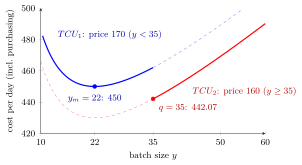
The blue curve is the total cost at price , which applies below units, and the red curve the total cost at price from on. The blue curve is lowest at , with cost per day. The red curve does not apply at , but at the threshold it costs , which is lower, so the optimal order is .
From the break on, every unit costs , so the total cost curve jumps down. Compare the best quantity on each side of .
Both curves have the same shape and differ only by the constant , so each is lowest at . On the discounted curve, the cheapest quantity that qualifies is if , and otherwise itself, since that curve rises to the right of . The comparison is therefore between at most two candidates, at the higher price and at the lower price.
The price-break indifference quantity turns this comparison into a threshold rule. A common slip is to take the discounted price at , which gives per day, but units do not qualify for that price.
Key Results
- Let . If , order at the discount price.
- If , compare the full costs at and and choose the cheaper; both are optimal at equality.
- This page treats as qualifying for the discount, as the worked examples do; check the convention when a problem states the threshold as .
- The discount is all-unit, not a discount only on units above the threshold.
Examples
- For phones, : cost at 22 is 450 per day, while cost at the qualifying 35 is about 442.07; order 35.
- For the snack bar, the 100-kilogram threshold is not worthwhile; the optimal quantity remains about 48.30.
Prerequisites
Related Concepts
Sources
- OR Modelling · Week 5
Aliases: quantity discount model, all-unit quantity discount model Symbols: square root
Last updated: 20 October 2026 03:02
EOQ with Price BreaksPrice-Break Indifference QuantityPurchasing CostEconomic Order Quantity