Forbidden Assignment
Definition
A forbidden assignment is an agent-task pair that is not allowed. In the course's Hungarian cost matrix, represent this pair by and leave that entry infinite during all transformations.
Interpretation
A forbidden assignment excludes one agent-task pair. The infinite cost turns the pair into a prohibition rather than an expensive option: no complete assignment that uses it can compete with one that avoids it.
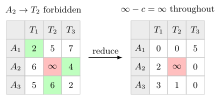
The entry for is before and after the row and column reductions, since subtracting a finite number from leaves . The highlighted optimal assignment avoids that cell: , , with cost .
A large finite number works only if it is large enough: here the cheapest assignment through costs , so must exceed . In the Hungarian algorithm, an infinite entry is never a zero, so it is never selected; in the binary formulation, the same ban is the constraint .
Key Results
- Do not apply finite row or column adjustments as if they made an infinite entry available.
- If no complete assignment avoiding forbidden pairs exists, the intended assignment problem is infeasible.
- In a binary formulation, the equivalent restriction is .
Examples
In the figure, prohibiting gives the highlighted assignment , , with cost . A finite penalty represents a prohibition only if it is sufficiently large and an allowed complete assignment exists; enforces the ban directly.
- A machine unable to process job 3 receives an infinite entry in that job's column.
- A feasible assignment must choose another machine for that job.
Prerequisites
Related Concepts
Sources
- OR Modelling · Week 5
Symbols: infinity
Last updated: 20 October 2026 03:02
Forbidden AssignmentAssignment ProblemHungarian AlgorithmInfeasible Linear Program