Ambulance Location Model
Definition
The ambulance location model selects a minimum number of station towns while ensuring that every town is within 18 minutes of a selected station. Let if a station is placed at town , and let . Then
Interpretation
The model answers one question: at how few towns must ambulance stations be placed so that every town has a station within 18 minutes? Each coverage constraint requires at least one sufficiently close station. A station may cover several towns, and a town may be covered by several stations.
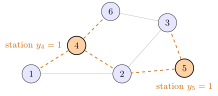
The dashed links join each chosen station to the towns it reaches within 18 minutes. The station at town 4 covers towns 1, 2 and 6 as well as itself, and the station at town 5 covers towns 2 and 3 and itself, so all six towns are covered and town 2 is covered twice.
Read as the set of towns from which town can be served in time, always including itself. The sum then counts the stations that serve town , and the constraint says that this count is not zero. The two constraints in the Examples, and , share no variable, so every feasible choice opens at least two stations; the figure shows that two suffice.
This is a binary integer program: each is a binary variable. The bus scheduling model has the same kind of coverage constraints with integer counts instead.
A common slip is to write the coverage constraints with instead of . That would forbid any town from being served by two stations, and the choice of towns 4 and 5 would become infeasible because of town 2.
Key Results
- Include the town itself because its travel time to itself is zero.
- The threshold includes exactly 18 minutes.
- This is the set-covering structure illustrated by the exercise; no station-capacity limit is specified.
Examples
The dashed links indicate travel times at most 18 minutes; the displayed positions are schematic rather than a geographical scale.
- Town 1 can be covered from towns 1 or 4, giving .
- Town 3 can be covered from towns 3 or 5, giving .
Prerequisites
Related Concepts
Sources
- OR Modelling · Week 2
Keywords: Emergency ambulance service, Set covering model Symbols: element of, sum
Last updated: 20 October 2026 03:02
Ambulance Location ModelBinary Integer ProgramBus Scheduling ModelMutually Exclusive Decisions