Trigonometric Functions
Definition
Let Consider the point on the unit circle obtained by rotating the point counterclockwise by an angle (measured in radians). The functions and are defined as the second and first coordinates of this point, respectively.
For all such that the tangent function is defined by
Interpretation
The trigonometric functions turn an angle into coordinates: and are the horizontal and vertical coordinates of the point reached by turning through the angle on the unit circle. Because a full turn of brings the point back to where it started, they provide periodic models for oscillatory behaviour.
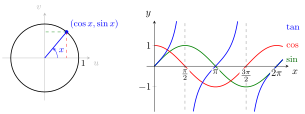
The point at angle on the unit circle is : is its horizontal coordinate (red dashed), its vertical one (green dashed), and . On the right the same coordinates are plotted against . The tangent has no value at and , where ; near these dashed lines its graph shoots up or down.
Standard facts can be read off the circle. The point lies on , so and both values lie in . Turning by more gives the same point, so and . Turning by instead of reflects the point in the horizontal axis, so and . The tangent is the slope of the line from the origin through the point; turning by a further gives the opposite point on the same line, which is why has period rather than .
A common slip is to measure the angle in degrees. Here is in radians, the length of the arc travelled on the unit circle, so a full turn is , and is the sine of one radian, about . In Math II, Euler's formula links sine and cosine to the exponential function.
Key Results
- Sine and cosine are defined for all real numbers.
- Trigonometric functions are periodic.
- Tangent is defined only where cosine is nonzero.
Examples
- and
- is undefined at
Prerequisites
Related Concepts
- Inverse Trigonometric Functions
- Cartesian Coordinate System
- Euler's Formula
- Complex Trigonometric Functions
- Periodic Function
Sources
- Math I: Calculus · Lecture 4
Aliases: trig functions, circular functions Keywords: sine, cosine, tangent Symbols: element of, pi, real numbers
Last updated: 20 October 2026 03:02
Trigonometric FunctionsInverse Trigonometric FunctionsComplex Trigonometric FunctionsPolar Coordinate SystemWeierstrass FunctionFunctionCartesian Coordinate SystemEuler's FormulaPeriodic Function