Limit at a Point
Definition
Let let be a function, and let be a limit point of We say that converges to as approaches and write
if for every there exists a number such that, for every
Some remarks:
- The point must be a limit point of the domain; itself need not belong to
- The condition excludes so the value is irrelevant to the limit.
- If the limit exists, it is unique.
- The - definition contains no motion: it is a precise implication between two inequalities. An opponent chooses the output tolerance we must answer with a valid input tolerance
Interpretation
The limit describes the value that approaches as gets arbitrarily close to regardless of whether is defined. The definition turns "approaches" into a test: every output tolerance around must be met by some input tolerance around .
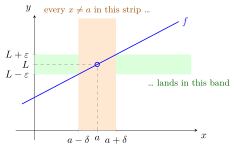
In the figure the point plays the role of , and is drawn with an open circle at , so the value at is left out. The horizontal band is around , the vertical band is . Since , the choice works for every , so .
The order of the quantifiers matters: is given first, and may depend on it. Once a positive works for a given , every smaller positive radius works too. Valid radii need not be unique; a tighter output tolerance does not force every choice of radius to become strictly smaller. The limit exists only if an answer exists for every , however small. The requirement that is a limit point of the domain guarantees that there are points with to test. At an isolated point the implication would hold vacuously for every , and the limit would not be unique.
The same pattern defines the limit of a sequence, with an index in place of , and the limit at infinity, with a bound . Using only one side of gives the one-sided limits, and requiring gives continuity. The idea returns later in the derivative, which is defined as a limit of this kind.
A common slip is to compute and call it the limit. The two agree only when is continuous at : is not defined at , yet .
Key Results
- Limits, if they exist, are unique.
- A function may have a limit at a point where it is not defined.
Examples
Prerequisites
Related Concepts
Sources
- Math I: Calculus · Lecture 5
Aliases: limit of a function at a point Keywords: function limit Symbols: delta, element of, epsilon, real numbers, subset
Last updated: 27 October 2026 11:52
Limit at a PointAsymptotic EquivalenceContinuityDerivative and DifferentiabilityDivergence to InfinityImproper IntegralLimit Laws for FunctionsOne-Sided LimitSqueeze Theorem for FunctionsBig-O and Little-o NotationsFunctionPunctured NeighbourhoodL'Hôpital's RuleSignum FunctionSingularity