Differentiability Class
Definition
Let be an open interval and let be an integer. A function is said to be in differentiability class if exists and is continuous on for every , where . A function is said to be infinitely differentiable, smooth, or in class if it has derivatives of all orders. On a closed interval, means that the interior derivatives extend continuously to both endpoints.
Interpretation
The differentiability class measures how smooth a function is: means that can be differentiated times and that and all these derivatives are continuous. A larger is a stronger requirement, so .
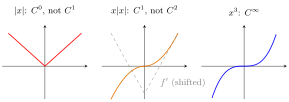
The three graphs climb this ladder at . The function is continuous but has a corner, so it is in but not in . The function is differentiable with derivative (dashed, shifted down), which is continuous but has a corner, so is in but not in . The cubic has derivatives , , , of all orders and is in .
The continuity of the derivatives is a real condition, not a formality. The function with is differentiable everywhere, with , but for has no limit as . So is differentiable on without being in . In the same way, a twice differentiable function need not be in .
Classes are the usual way to state how much smoothness a theorem needs. Math IV, for instance, works with twice continuously differentiable functions of several variables.
Key Results
- A function in class has continuous derivatives up to order
- The class contains all continuous functions.
- The class is contained in
- Smooth functions belong to all differentiability classes.
Examples
- Polynomial functions belong to
- The function belongs to but not to
Prerequisites
Related Concepts
Sources
- Math I: Calculus · Lecture 9
Aliases: smoothness class Keywords: continuously differentiable function, smooth function Symbols: element of, infinity, real numbers, subset
Last updated: 20 October 2026 03:02
Differentiability ClassIntegration by Substitution Type 1Integration by Substitution Type 2Higher-Order Symmetry of PartialsHigher-Order DerivativeContinuityReal Analytic FunctionSymmetry of Second DerivativesTwice Continuous Differentiability on R^n