Natural Number
Definition
We define the natural numbers using the Peano axioms. The natural numbers are abstract objects that satisfy the following axioms:
- The number is a natural number.
- For every natural number its successor is also a natural number.
- For every natural number the successor is not
- If for natural numbers and then
- Let be a statement about a natural number If is true, and if implies for every natural number then is true for every natural number
The set of natural numbers is denoted as informally, and excludes Once addition is available, the successor is simply
Interpretation
Natural numbers provide the foundational objects for counting and induction. The Peano axioms do not construct them from earlier number systems; they describe them by a starting point and a single step, the successor .
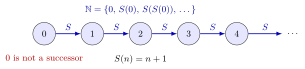
The figure shows the chain , each arrow one application of . No arrow points to (axiom 3), no number receives two arrows (axiom 4), and every number is reached from in finitely many steps, so (axiom 5).
Each axiom rules out a different wrong picture. Without axiom 3, the chain could return to , like the hours on a clock with . Without axiom 4, it could run into a loop later: on with , and , the number is the successor of two numbers. Without axiom 5, extra elements that are never reached from could be added.
Axiom 5 is the principle of mathematical induction, and the same start-and-step pattern defines quantities recursively, such as the factorial.
Conventions differ between texts: some start the natural numbers at . On this page and ; check which convention a source uses before applying a statement about all .
Key Results
- The Peano axioms characterize the natural numbers: any two systems satisfying them differ only in the names of their elements.
- Axiom 5 is the principle of mathematical induction: every induction proof has a base case and an inductive step.
- Axiom 3 prevents the counting process from cycling back to axiom 4 says two different natural numbers cannot share a successor.
- Under the decimal system, natural numbers include
Examples
- By induction (axiom 5), for every it holds for and if it holds for then adding gives
Prerequisites
Related Concepts
Sources
- Math I: Calculus · Lecture 1
Aliases: nonnegative integer Keywords: whole number, counting number, Peano axioms Symbols: element of, natural numbers
Last updated: 20 October 2026 03:02
Natural NumberAddition and SumFactorialFinite and Infinite SetsIntegerMathematical InductionAleph NullCountable and Uncountable SetsSetSequence