-test
Proposition
Let be a positive real number. The improper integral converges if and only if the improper integral converges if and only if
Interpretation
The -test settles the improper integrals of powers , which serve as the reference integrals in the comparison test. Towards infinity, must decay fast enough, which needs ; towards , it must not blow up too fast, which needs .
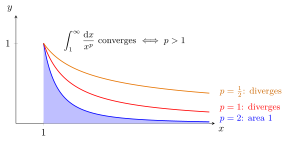
All three curves decrease to , but only the area under is finite, and it equals . Under the area from to is , and under it is ; both grow without bound as .
The test is a direct computation. For ,
which has a finite limit as exactly when . In the same way, has a finite limit as exactly when , and for both limits are infinite because of . The value of plays no role: moving it changes the integral only by an ordinary integral over a bounded interval.
The two conditions point in opposite directions, so no power is integrable over all of : diverges for every . Through the integral test, the first statement settles the -series, and the second shows where the integral defining the gamma function converges near .
Key Results
- The convergence depends solely on the interval and the value of
- Behaviour near infinity and near zero are treated separately and differently.
Examples
- converges.
- diverges.
Prerequisites
Related Concepts
Sources
- Math I: Calculus · Lecture 12
Aliases: p test Symbols: epsilon, infinity, integral, square root
Last updated: 20 October 2026 03:02
p-testComparison Test for Improper Integralsp-seriesImproper IntegralIntegral Test for ConvergenceHarmonic SeriesGamma Function