Antiderivative
Definition
Let be an interval, and let A function is an antiderivative of on if at every interior point of with one-sided derivatives at included endpoints.
Interpretation
An antiderivative of is a function whose derivative is , so finding one reverses differentiation: given the slope at every point, recover a function with those slopes.
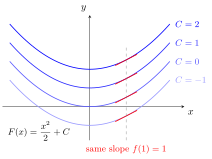
The figure shows antiderivatives of : the curves for are vertical shifts of one another. At their tangent segments are parallel, all with slope . Shifting a graph up or down does not change its slopes, which is why is again an antiderivative.
The derivative is the test for an antiderivative: differentiating must give . At an included endpoint of only a one-sided derivative is available, so the condition there is one-sided, while at interior points it is two-sided.
Not every function has an antiderivative. The signum function has none on : an antiderivative would be plus a constant on and plus a constant on , and continuity at would force it to be , which is not differentiable at . Every continuous on does have one, the area function of the fundamental theorem of calculus, part 1.
Antiderivatives are what make integrals computable: part 2 of the fundamental theorem evaluates as , and the set of all antiderivatives is the indefinite integral.
Key Results
- If is an antiderivative of on an interval then so is for any constant
- Antiderivatives are not unique; on an interval, any two antiderivatives of differ by a constant.
- Every continuous function on an interval has an antiderivative, but an integrable function need not have one: the signum function is integrable on and has no antiderivative there.
Examples
- If then is an antiderivative of
- If then is an antiderivative of
Prerequisites
Related Concepts
Sources
- Math I: Calculus · Lecture 11
Aliases: primitive, primitive function Symbols: element of, integral, real numbers
Last updated: 20 October 2026 03:02
AntiderivativeFundamental Theorem of Calculus Part 2Indefinite IntegralDifferential EquationIntegrating FactorEndpoint and Bounded IntervalDerivative and DifferentiabilityRiemann IntegralFundamental Theorem of Calculus Part 1Integration by Parts