Monotone Convergence Theorem
Theorem
Let be a sequence of real numbers which has some finite upper bound and which is also monotonically increasing. Then is convergent, and where is the supremum of the set
Interpretation
The monotone convergence theorem gives convergence from two facts that are often easy to check: the sequence never goes down, and it never rises above a fixed number . It also names the limit, the supremum of the terms, so the limit need not be guessed in advance as in the definition of a limit.
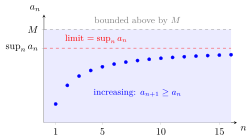
The figure shows , which starts at and rises with every step. The upper dashed line is one upper bound ; the lower one is the least upper bound, , and the terms approach this line rather than .
The proof shows why the limit is the supremum. Given , the number is not an upper bound, so some lies above it, and since the sequence is increasing, every later term lies between and . Both hypotheses are needed: is increasing but unbounded, and the bounded sequence is not monotone; neither converges. A decreasing sequence that is bounded below converges to its infimum.
The theorem relies on the completeness of the real numbers and fails in : the decimal truncations of form an increasing, bounded sequence of rationals with no rational limit. Euler's number is the limit of such an increasing bounded sequence, , as the Examples show.
A common slip is to take the bound for the limit. The theorem only gives ; the limit is the least upper bound.
Key Results
- Every bounded monotone sequence is convergent.
- The limit is given by the supremum or infimum (given a decreasing sequence with lower bound) of the sequence.
Examples
- exists since is an increasing sequence with an upper bound
- For the partial sums form an increasing sequence that is bounded above: for an integer each term with is at most so for all Hence exists by the monotone convergence theorem. (For the partial sums are not monotone, and the series converges for a different reason.)
Prerequisites
Related Concepts
Sources
- Math I: Calculus · Lecture 3
Aliases: MCT Symbols: element of, epsilon, infinity, rational numbers, real numbers, square root, sum
Last updated: 20 October 2026 03:02
Monotone Convergence TheoremLimit of a SequenceMonotone SequenceBounded SequenceSupremumEuler's Number