Infimum
Definition
Let be nonempty and bounded below. The infimum of is its greatest lower bound, denoted by
Interpretation
The infimum is the greatest value that does not exceed any element of a set: among all lower bounds of , it is the largest. It provides a precise way to describe how far down a set reaches, even when no minimum exists.
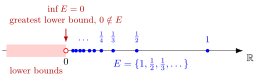
For , every number is a lower bound, and no positive number is one, since once . So the shaded lower bounds end exactly at , and although ; the set has no minimum.
The definition has two parts, and the interactive figure tests both. A number is the infimum of if and only if is a lower bound of and, for every , some satisfies . The first part says that is low enough; the second says that nothing larger works, because is not a lower bound. This is the usual way to verify an infimum, as for in the Examples.
A common slip is to think that the infimum must belong to the set. It does exactly when the set has a minimum, and then . Another is to expect an infimum in every number system: in , the set is bounded below but has no greatest rational lower bound, since its infimum in is . The infimum mirrors the supremum: , where .
Key Results
- By the greatest-lower-bound property (see real number) of every nonempty subset of that is bounded below has a unique infimum.
- An infimum need not belong to the set; it is a minimum exactly when it is attained.
- In the extended real numbers, one uses the conventions for a nonempty set with no lower bound and neither nor is a real number.
Examples
- The infimum of is
- The infimum of is
Prerequisites
Related Concepts
Sources
- Math I: Calculus · Lecture 3
Aliases: greatest lower bound, inf Symbols: element of, epsilon, infinity, rational numbers, real numbers, square root, subset
Last updated: 20 October 2026 03:02
InfimumLimit Superior and Limit InferiorLower BoundSupremumMinimum of a SetBounded SetBounded Function