One-Sided Continuity
Definition
Let and let be a function. Let
Assume that there exists an such that is defined for every We say that is right-continuous at if for every there exists a number with such that
Assume that there exists an such that is defined for every We say that is left-continuous at if for every there exists a number with such that
Interpretation
One-sided continuity asks for continuity at using the points on one side only: is right-continuous at if is close to for all close to , and left-continuous if the same holds for . Equivalently, the one-sided limit from that side exists and equals .
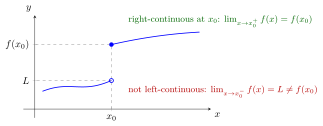
The function in the figure jumps at . From the right the values start at the filled point and stay close to it, so and is right-continuous at . From the left the values approach the lower height at the open circle, so is not left-continuous at , and therefore not continuous there.
The comparison is always with the value itself, so including the point in costs nothing: there the inequality reads . Moving the filled point in the figure down to height would make left-continuous instead of right-continuous: which side is continuous depends on where the value at the jump is placed.
One-sided continuity is what remains of continuity at an endpoint of an interval: a function on is continuous at exactly when it is right-continuous there.
A common slip is to read "right-continuous at " as "continuous on an interval to the right of ". The definition concerns the single point : a function can be continuous on and still fail to be right-continuous at .
Right-continuity returns in probability theory: every cumulative distribution function is right-continuous.
Key Results
- Right-continuity and left-continuity are defined using one-sided limits.
- If is defined on a neighbourhood of then is continuous at if and only if it is both right-continuous and left-continuous at At an endpoint of the domain, continuity coincides with the one-sided continuity that is available there.
Examples
- The floor function (the largest integer ) is right-continuous but not left-continuous at every integer; the ceiling function (the smallest integer ) is left-continuous but not right-continuous there.
Prerequisites
Related Concepts
Sources
- Math I: Calculus · Lecture 5
Aliases: right-continuous, left-continuous, continuous from the right, continuous from the left Keywords: right-continuity, left-continuity Symbols: delta, element of, epsilon, real numbers, subset
Last updated: 22 October 2026 19:04
One-Sided ContinuityContinuityOne-Sided LimitOne-Sided DerivativeFloor and Ceiling Functions