Proper Subset
Definition
Let and be sets. We say that is a proper subset of denoted unambiguously by if every element of is also an element of but some element of is not in Equivalently,
Interpretation
A proper subset captures strict inclusion between sets: means that lies inside and has at least one element left over. It distinguishes containment from equality.
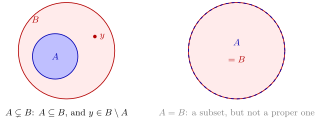
In the left panel the disc lies inside , and the marked point belongs to but not to . This one point, , is what makes the inclusion strict. In the right panel the two discs coincide: is still a subset of , but not a proper one.
The definition has two parts, and so does a proof: show , then name one witness in . For example, with witness , and the empty set is a proper subset of every nonempty set. For finite sets, a proper subset has fewer elements: .
Notation is a common source of confusion. Some texts write for , others for . The Definition therefore uses , which has only one reading; when a source writes , check which meaning it intends.
Key Results
- Every proper subset is a subset, but not conversely.
- Proper inclusion is transitive, i.e., and implies
Examples
- A set is never a proper subset of itself.
Prerequisites
Related Concepts
Sources
- Math I: Calculus · Lecture 1
Aliases: strict subset Symbols: element of, natural numbers, subset, there exists
Last updated: 22 October 2026 19:04
Proper SubsetSubsetEmpty SetDifference SetSingleton Set