Chain Rule
Proposition
Let be subsets of let and and let be a function such that and such that is differentiable at Suppose that is a function which is differentiable at Then the composition function is differentiable at and its derivative is given by
Interpretation
The chain rule describes how differentiation behaves under composition: if depends on and depends on , the rate of change of with respect to is the product of the two intermediate rates. It formalizes the propagation of rates of change through intermediate variables.
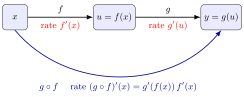
The figure reads the formula from left to right. A small change in is multiplied by to give the change in , and that change is multiplied by to give the change in . The composite rate on the curved arrow is the product , with evaluated at , the point that is sent to, not at .
In Leibniz notation, with and , the rule reads
It looks like cancelling , which is a useful memory aid but not a proof: the derivatives are limits, not fractions. The hypotheses ask for differentiability of at and of at the point that is actually used. They are sufficient, not necessary: is not differentiable at , yet is differentiable at .
A common slip is to forget the inner derivative: , not .
The rule returns later: it gives the derivative of an inverse function in the inverse function theorem, read backwards it becomes integration by substitution, and Math IV extends it to functions of several variables in the multivariable chain rule.
Key Results
- The composition of differentiable functions is differentiable.
- The derivative of a composition is the product of derivatives evaluated at appropriate points.
Examples
- If and then
- If and then
Prerequisites
Related Concepts
Sources
- Math I: Calculus · Lecture 6
Symbols: element of, real numbers
Last updated: 27 October 2026 11:52
Chain RuleIntegration by Substitution Type 1Integration by Substitution Type 2First-Order Differential EquationIntegrating FactorDerivative and DifferentiabilityComposition of FunctionsDifferentiation RulesInverse Function Theorem