Complement
Definition
Let where is a fixed universal set. The complement of relative to is
The complement is the difference set once the universal set has been fixed.
Interpretation
The complement contains everything in the chosen universe that does not belong to the set. It therefore depends on which universal set is being used: for , the complement is when , but when .
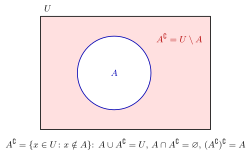
The rectangle is and the disc is ; the shaded region outside the disc is . The disc and the shaded region do not overlap and together fill the rectangle, which is and ; taking the complement of the shaded region gives back the disc.
In logical terms, the complement is "not": means and . A common slip is to distribute the complement without switching the operation: with , and , we get , whereas . De Morgan's laws give the correct rule.
The idea returns in probability as the complement of an event: the event that a given event does not happen.
Key Results
- and
-
De Morgan's laws:
Examples
- If and then
- If and then
Prerequisites
Related Concepts
Sources
- Math I: Calculus · Lecture 1
- Math II: Linear Algebra · Week 1 (set-theory recall)
Aliases: set complement, absolute complement Symbols: element of, infinity, intersection, real numbers, subset, union
Last updated: 20 October 2026 03:02
ComplementComplement of an EventSetDifference SetUnion of SetsIntersection of SetsDisjoint SetsOpen and Closed Sets in a Metric Space