Extended Real Number
Definition
We can extend the real number system to include and , resulting in the extended real number system denoted as it consists of all real numbers together with the two symbols and ordered so that for every real
Interpretation
The extended real number system augments the real numbers by symbols for positive and negative infinity, placed as a least and a greatest element. This extension allows limits, divergence and unbounded behaviour to be described within a single framework.
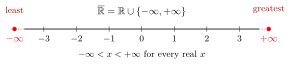
The figure draws as the real line with two endpoints attached. Every real lies strictly between them, , and the order of is kept. With these endpoints every nonempty set of real numbers has a supremum and an infimum in : a set without an upper bound, such as in the Examples, gets the supremum .
The gain lies in the order, not in arithmetic. A common slip is to treat as a very large real number and compute with it. Some operations have a natural value, such as for real , but has none: and both tend to with for every , while and give . Likewise, a sequence with limit is still called divergent, because convergence asks for a real limit .
Key Results
- Infinities are symbols, rather than big numbers.
- Many limit statements naturally take values in the extended real numbers.
Examples
The sequence has extended-real limit , and the set has supremum in . Neither statement makes infinity an ordinary real number: expressions such as are not defined by real arithmetic.
Prerequisites
Related Concepts
Sources
- Math I: Calculus · Lecture 3
Aliases: extended real line Symbols: infinity, real numbers
Last updated: 20 October 2026 03:02
Extended Real NumberAsymptotic EquivalenceL'Hôpital's Rulep-norm and p-metricReal NumberDivergence to InfinityLimit at InfinityInfinity