Higher-Order Derivative
Definition
The derivative is itself a function. If is differentiable, its derivative is the second derivative
and we may continue whenever the next derivative exists, obtaining and so on. These are the higher-order derivatives of
Let be an open interval and let be an integer. A function is -times differentiable on if the derivatives exist at every point of Recursively, and for we also set A function with derivatives of every order is called infinitely differentiable or smooth.
Interpretation
Higher-order derivatives measure change of change: is the rate of change of , is the rate of change of , and so on. If is the position of an object at time , then is its velocity and its acceleration.
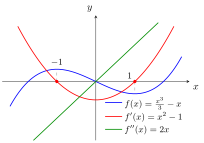
Each curve is the slope of the one before it. Where the red curve crosses , at (dashed lines), the graph of is flat: these are its stationary points. The green line is negative at , so is decreasing there and has a local maximum; it is positive at , where has a local minimum.
The second derivative tells how the graph bends: on an interval makes convex there and makes it concave. This is the basis of the second-order condition for extrema and of inflection points; in the figure the graph of changes from concave to convex at , where changes sign.
Two slips are common. The brackets in matter: is the second derivative, while is a power; for , but . And a twice differentiable function need not have a continuous second derivative; that stronger property is the differentiability class . Higher derivatives return in Math III as the coefficients of the Taylor polynomial.
Key Results
- Higher-order derivatives are defined recursively.
- Smooth functions admit derivatives of all orders.
- Second derivatives are particularly important for shape analysis.
Examples
- If then
- Polynomial functions have derivatives of all orders.
Prerequisites
Related Concepts
- Convexity and Concavity
- Taylor Series
- Hessian Matrix
- Inflection Point
- Second-Order Partial Derivative
- Twice Continuous Differentiability on
Sources
- Math I: Calculus · Lecture 9
Aliases: higher order derivative, n-th derivative Symbols: real numbers, subset
Last updated: 20 October 2026 03:02
Higher-Order DerivativeDifferentiability ClassSecond-Order ConditionTaylor's TheoremMoments from the MGFDifferential EquationSecond-Order Differential EquationAbsolute Risk AversionDerivative and DifferentiabilityConvexity and ConcavityTaylor SeriesHessian MatrixInflection PointSecond-Order Partial DerivativeTwice Continuous Differentiability on R^n