Continuity
Definition
Let and We say that is continuous at if for every there exists such that, for every
The function is continuous on if it is continuous at every point of
Interpretation
Continuity expresses the idea that small changes in the input of a function lead to small changes in its output. At a point this means: however close to we want the value to be, we can achieve it by taking close enough to .
In the definition the tolerance comes first and is arbitrary; then a must be found, and it may depend on and on . Geometrically, the part of the graph above must lie in the horizontal band of height around . Unlike the limit at a point, the point itself is included and the target is the actual value , so must be defined at .
Continuity at can fail in several ways, matching the kinds of singularity: the limit exists but differs from , the one-sided limits are different, as for the signum function at , or the values become unbounded or keep oscillating. The Dirichlet function is continuous at no point at all.
A common slip is to take "can be drawn without lifting the pen" as the definition. Continuity is checked point by point, and only at points of the domain: is continuous, as the Examples explain, although its graph consists of two separate pieces. The pen picture fits continuous functions on an interval, the setting of the intermediate value theorem and the extreme value theorem.
Math III later replaces by a general distance in continuity between metric spaces.
Key Results
- If is a limit point of continuity at is equivalent to the limit at that point satisfying endpoints use the corresponding one-sided limit.
- Sums, differences, products, quotients (where defined), maxima and minima of continuous functions are continuous.
- If and is continuous at then so a continuous function may be interchanged with a limit.
- Standard facts used from here onwards. Each of the following is continuous at every point of its domain: polynomials, and rational functions wherever the denominator is nonzero; the power functions on and on its natural domain; the exponential functions and the logarithms for the trigonometric functions and on and wherever and the absolute value
Examples
- The function is continuous on
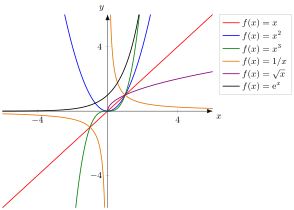
- The function is a continuous function: it is continuous at every point of its domain The point lies outside the domain; there the values become unbounded, which is classified as an infinite discontinuity of (see Singularity), but this does not make a discontinuous function.
Prerequisites
Related Concepts
Sources
- Math I: Calculus · Lecture 5
Keywords: continuous function Symbols: alpha, delta, element of, epsilon, infinity, real numbers, square root
Last updated: 20 October 2026 03:02
ContinuityDifferentiability ClassExtreme Value TheoremFundamental Theorem of Calculus Part 1Integral Test for ConvergenceIntegration by Substitution Type 1Integration by Substitution Type 2Intermediate Value TheoremInverse Function TheoremMean Value TheoremOne-Sided ContinuityRolle’s TheoremSingularityContinuity between Metric SpacesHeine-Cantor TheoremWeierstrass Approximation TheoremLimit at a PointUniform ContinuityDerivative and DifferentiabilityDirichlet Function