Subset
Definition
Let be sets. We say that is a subset of denoted if every element of is also an element of i.e.,
Interpretation
A subset describes containment between collections of objects: means that whatever belongs to also belongs to . The definition allows .
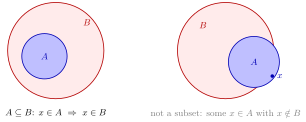
In the left panel the disc lies entirely inside , so every is also in . In the right panel sticks out of , and the single marked point with is enough to show that . To prove , take an arbitrary and show ; to disprove it, one point of outside suffices.
Since the definition is an implication, there is nothing to check when , which is why the empty set is a subset of every set. Inclusion in both directions gives equality: and together mean . A proper subset adds the requirement .
A common slip is to expect any two sets to be comparable, as any two numbers are under : neither nor holds.
Key Results
- Every set is a subset of itself.
- Subset relations are transitive, i.e., and implies
- Proper subsets exclude equality.
Examples
- is a subset of every set.
Prerequisites
Related Concepts
Sources
- Math I: Calculus · Lecture 1
Symbols: element of, subset
Last updated: 20 October 2026 03:02
SubsetIntervalProper SubsetPower SetSubspaceEventAdherent Point and Closure of a SetClosed Metric BallOpen Metric BallTopology and Topological SpaceSetEmpty SetUnion of Sets