Exponential Function
Definition
Functions are called exponential functions, where is known as the base of the exponential function. One of the most important exponential functions is the natural exponential function with using exponentiation with a fixed positive base and a varying exponent; its base is Euler's number
Interpretation
Exponential functions model processes where growth or decay is proportional to the current value. For , increasing by multiplies the value by , since : equal steps in give equal factors, not equal increments.
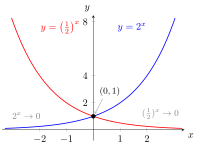
Both curves pass through because for every base. The curve doubles with each unit step to the right, through , and at , and approaches far to the left. The curve is its mirror image in the -axis. Neither curve meets the -axis, because for all .
The base must be positive for to be defined for every real : is not a real number. A base gives growth, decay and a constant; the factor is the starting value and fixes the sign. For the logarithm with base is the inverse of , and , so every exponential function is a rescaled version of .
A common slip is to confuse , where the exponent varies, with the power function , where the base varies. The exponential eventually wins: for all , although .
Key Results
- The exponential function is always positive; a scaled exponential function therefore has the sign of
- The exponential function is continuous and differentiable everywhere.
- The natural exponential function is its own derivative.
Examples
- describes exponential growth.
- describes exponential decay.
Prerequisites
Related Concepts
Sources
- Math I: Calculus · Lecture 4
Aliases: natural exponential function, exp Symbols: real numbers
Last updated: 20 October 2026 03:02
Exponential FunctionLogarithm and Logarithmic FunctionComplex Exponential FunctionExponential DistributionLognormal DistributionNormal DistributionPoisson DistributionExponential LimitMoment Generating FunctionCharacteristic Equation for a Differential EquationFirst-Order Differential EquationMatrix ExponentialInterest and DiscountingExponentiation and PowerEuler's NumberMonomial and Power FunctionDerivative and Differentiability