Stationary Point
Definition
For a differentiable function a stationary point of is a point where its derivative is zero, i.e., the corresponding point on the graph of is sometimes also called a stationary point.
Interpretation
A stationary point is a point where the derivative is zero: the tangent to the graph is horizontal, and to first order the function is not changing there. Stationary points are the candidates for local extrema of a differentiable function at interior points.
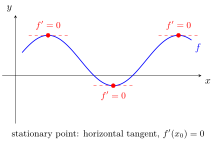
The curve in the figure has three stationary points, each marked with a horizontal tangent: two peaks, which are local maxima, and a valley between them, which is a local minimum. At each of them the curve turns from rising to falling or the other way round, so changes sign there.
A zero derivative alone does not say what happens nearby: the function may have a peak, a valley or neither, as at shows. Whether a stationary point is a local extremum has to be checked by comparing with for near ; the second-order condition later gives a shortcut.
Every stationary point is a critical point, but critical points also include points where does not exist; for a differentiable function the two notions coincide.
A common slip is to confuse a stationary point with a zero of . The condition is , not : has a stationary point at but no zeros.
Stationary points return for functions of several variables in Math III and Math IV, with the gradient equal to zero in place of .
Key Results
- Not every stationary point corresponds to an extremum.
- Stationary points must be analysed further to determine behaviour.
Examples
- The function has a stationary point at
- The function has a stationary point that is not an extremum.
Prerequisites
Related Concepts
Sources
- Math I: Calculus · Lecture 6
Symbols: element of, real numbers
Last updated: 20 October 2026 03:02
Stationary PointDerivative and DifferentiabilityGraph of a FunctionCritical PointLocal ExtremumFirst-Order ConditionZero of a FunctionGradientRolle’s Theorem