Trichotomy of Real Numbers
Proposition
For any two real numbers and exactly one of the following is true: or Equivalently, for any real number exactly one of the following is true: is zero, is positive, or is negative.
Interpretation
Trichotomy says that any two real numbers are comparable; together with transitivity of it makes totally ordered. It ensures that comparisons between real numbers are always decisive.
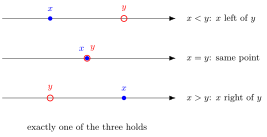
The three number lines show the three possible positions of two points and : to the left of , both at the same point, or to the right of . Every pair of real numbers fits exactly one picture. The two forms in the Proposition are linked by the difference: , or exactly when is negative, zero or positive.
"Exactly one" has two parts: at least one case holds, so there are no incomparable pairs, and at most one holds, so the cases do not overlap. Both are used in proofs by cases. For instance, if for every , then : otherwise , and would give . A common slip is to negate as ; by trichotomy the negation is , which includes .
Key Results
- Exactly one of three relations holds between any two real numbers.
- Trichotomy underpins order-based arguments.
- Many proofs rely on splitting cases via trichotomy.
Examples
- For and exactly one relation holds, namely because
Prerequisites
Related Concepts
Sources
- Math I: Calculus · Lecture 2
Aliases: law of trichotomy, trichotomy Symbols: epsilon, real numbers, square root
Last updated: 20 October 2026 03:02
Trichotomy of Real NumbersReal NumberInequalityAbsolute ValueComplex Number