Partition of an Interval
Definition
A partition of is a finite ordered set
Its subintervals are for and its mesh is
If all subintervals have equal length, then is a regular subdivision.
Interpretation
A partition cuts into finitely many consecutive subintervals at the points . It is the bookkeeping behind every Riemann sum: the function is approximated separately on each subinterval and the pieces are added up. A regular subdivision is the simplest choice, with all pieces of the same length.
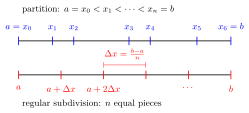
The upper line is a partition with pieces of different lengths; its mesh is the length of the widest piece, here . The lower line is a regular subdivision with points : every piece has length , and this is also its mesh.
The conditions in the definition make the pieces fit together. The points increase strictly, so every piece has positive length, and the first and last points are and , so the pieces cover and overlap only at shared endpoints. The mesh measures fineness because it controls all pieces at once; many points alone are not enough. If and all further points lie in the right half, then however large is. For a regular subdivision the two notions agree, since exactly when . This is why limits over regular subdivisions, as for the Riemann integral, are taken as .
A common slip is to identify with its subintervals. is the set of cut points, so a partition into pieces has points, and neighbouring subintervals and share the point .
Key Results
- Length is finitely additive: for every partition of
- Every closed interval with admits partitions of arbitrarily small mesh.
- Regular subdivisions are special cases of partitions; the regular subdivision of into pieces has mesh
Examples
- Dividing into equal subintervals forms a regular subdivision.
- Irregular partitions allow variable subinterval lengths.
Prerequisites
Related Concepts
Sources
- Math I: Calculus · Lecture 10
Aliases: partition of a closed interval Keywords: regular subdivision, mesh, mesh of a partition, subinterval Symbols: delta, infinity, sum
Last updated: 27 October 2026 11:52
Partition of an IntervalRiemann SumLength of an IntervalRiemann IntegralInterval