Finite Sequence
Definition
A finite sequence is an ordered list with only finitely many entries, with integers (usually or ), written It has terms. In contrast, a sequence never ends.
Interpretation
A finite sequence is an ordered list of numbers with a first and a last term: comes first, comes last, and each index in between carries exactly one term.
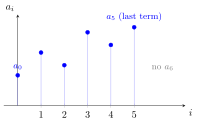
The figure shows : one stick for each index , so terms, and nothing after the last term . The position along the axis is the index; the height of the stick is the value of the term.
Order and repetition both matter: and are different, and has three terms although the set has two elements. Counting terms is a common slip: has terms, not . Later, the terms of a finite sequence are added up as a finite series.
Key Results
- Finite sequences have a last term.
- Every finite sequence can be viewed as a function on a finite index set.
- Finite sequences are always bounded.
Examples
- is a finite sequence.
- consists of a single term
Prerequisites
Related Concepts
Sources
- Math I: Calculus · Lecture 2
Last updated: 20 October 2026 03:02
Finite SequenceFinite SeriesSequenceBounded Sequence