Integration by Parts
Proposition
Let and be differentiable functions on with and Riemann integrable. Then:
or
If we consider the indefinite integral, we get:
Interpretation
Integration by parts is the product rule read backwards. Since , integrating gives back, so an integral of can be traded for an integral of plus a boundary term. This helps when differentiating makes it simpler while is easy to integrate.
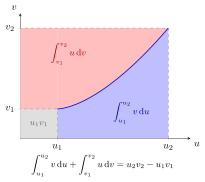
Put and . As runs from to , the point traces the curve from to . The area below the curve is and the area to its left is ; together they fill the large rectangle minus the small one, so . With , and so on, this is the second form of the formula. The picture assumes increasing positive and ; the formula does not.
The differential notation rewrites the same product-rule integral. It identifies which factor is differentiated; it does not make an unrelated integration variable.
The choice of and decides whether the method helps. For , taking turns the new integrand into . The opposite choice , is a common slip: it leads to , which is harder than the original.
The same step proves the recursion of the gamma function. If the integrand is not defined at an endpoint, first work away from that endpoint and then take a limit, as in the second Example; this procedure also applies to improper integrals.
Key Results
- Integration by parts follows directly from the product rule.
- The method can be applied to both definite and indefinite integrals.
- Appropriate choice of functions is essential for simplification.
Examples
- Choose and . Then and , so .
- The expression is not defined at zero but tends to there, so it has a continuous extension to . To evaluate its integral, apply integration by parts first on , with and :
Since as , the integral equals .
Prerequisites
Related Concepts
Sources
- Math I: Calculus · Lecture 12
Aliases: IBP, partial integration, integrate by parts Symbols: epsilon, gamma, integral, pi
Last updated: 27 October 2026 11:52
Integration by PartsDifferentialDifferentiation RulesDefinite IntegralIndefinite IntegralIntegration by Substitution Type 1Integration by Substitution Type 2Antiderivative