Rolle’s Theorem
Theorem
Let be real numbers, and consider a function that is continuous on the interval and differentiable on If we have then there exists a for which
Interpretation
Rolle’s theorem guarantees a stationary point between two points where a function takes the same value, : a graph without breaks or corners that leaves a height and comes back to it must be flat somewhere in between.
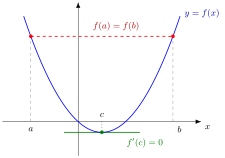
The parabola takes the same value at and , and the horizontal tangent sits at its lowest point . This is how the proof goes. By the extreme value theorem, attains a maximum and a minimum on . If both occur at the endpoints, is constant and every works; otherwise one of them lies at an interior point , and there by the first-order condition.
Each hypothesis closes a gap. Without differentiability, on has equal endpoint values but a corner at instead of a horizontal tangent. Without continuity at an endpoint, on with has , while throughout . The point need not be unique: on the sine has two such points, and .
The mean value theorem follows by applying Rolle’s theorem to minus its secant line. Rolle’s theorem also limits the number of zeros: between two zeros of a differentiable lies a zero of , so if has no zero on an interval, has at most one there. For example, has , so it has at most one zero, and the intermediate value theorem gives exactly one, in .
Key Results
- Continuity and differentiability are essential hypotheses.
- The conclusion guarantees existence but not uniqueness.
- Rolle’s theorem is a special case of the mean value theorem.
Examples
- The function on satisfies Rolle’s theorem.
- The sine function satisfies the hypotheses on suitable intervals.
Prerequisites
Related Concepts
Sources
- Math I: Calculus · Lecture 7
Symbols: element of, pi, real numbers
Last updated: 20 October 2026 03:02
Rolle’s TheoremContinuityDerivative and DifferentiabilityMean Value TheoremStationary PointLocal Extremum