Rational Function
Definition
A rational function is the quotient of two polynomials when the denominator is not always equal to zero.
Interpretation
A rational function divides one polynomial by another, . It behaves like a polynomial wherever the denominator is nonzero; its special features come from the zeros of and from comparing the degrees of and .
The natural domain is the set of with . Because is not the zero polynomial, it has at most zeros, so only finitely many points are left out. Near a zero of there are two cases. If , the values become arbitrarily large as approaches , as for near . If as well, the factor can be cancelled from numerator and denominator, and after cancelling the function may behave perfectly well near : for every .
For large only the leading terms matter. If , the values get close to ; if the degrees are equal, they get close to the ratio of the leading coefficients; if , they grow without bound. In the third Example, , and division gives
where the last term is small for large , so the graph runs close to the line .
A common slip is to simplify first and read off the domain afterwards. The functions and agree everywhere except at , where only the second is defined. Later these patterns are made precise with limits, as vertical and horizontal asymptotes.
Key Results
- Rational functions are undefined where the denominator vanishes.
- The behaviour as including any horizontal asymptote, is determined by the degrees and leading coefficients of the two polynomials.
- A rational function is continuous at every point of its domain; the zeros of the denominator are excluded from the domain, not points of discontinuity.
Examples
- is a rational function.
- is undefined at
- is defined everywhere.
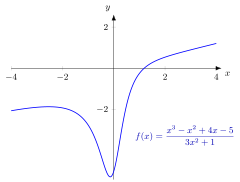
The denominator never vanishes, so the graph is one unbroken curve over all of .
Prerequisites
Related Concepts
Sources
- Math I: Calculus · Lecture 4
Symbols: infinity, real numbers
Last updated: 20 October 2026 03:02
Rational FunctionPolynomialDivision and QuotientHorizontal AsymptoteVertical AsymptoteIndeterminate FormReciprocal