Harmonic Series
Definition
The harmonic series is an infinite sum of the reciprocals of positive integers, i.e.,
Interpretation
The harmonic series is the standard example of an infinite series whose terms tend to zero but whose sum diverges. It shows that vanishing terms are necessary for convergence, but not sufficient.
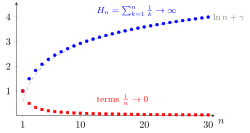
The terms shrink towards , but the partial sums keep climbing, close to the dashed curve with . The growth is slow, and , but there is no upper bound, so diverges to infinity. The grouping argument in the Examples proves this: every block of terms between consecutive powers of two adds at least .
A common slip is to conclude from , or from partial sums that seem to level off in a computation, that the series converges. The condition that the terms tend to can only rule convergence out, never prove it.
The harmonic series is the benchmark on the divergent side: by the comparison test, any series with nonnegative terms at least , such as , diverges as well. With alternating signs the picture changes: converges by the alternating series test, to . The harmonic series returns as the borderline case of the -series .
Key Results
- The harmonic series diverges to infinity.
- Divergence occurs despite terms decreasing to zero.
Examples
Group the terms of the partial sum into blocks ending at powers of two. For each , the block from to contains terms, each at least . Thus every block contributes at least , and
The partial sums are increasing, so the whole sequence of partial sums diverges to infinity, even though .
Prerequisites
Related Concepts
Sources
- Math I: Calculus · Lecture 10
Symbols: gamma, infinity, square root, sum
Last updated: 20 October 2026 03:02
Harmonic SeriesInfinite SeriesReciprocalComparison Test for Seriesp-seriesp-testIntegral Test for Convergence