Asymptotic Equivalence
Definition
Let and be defined near with sufficiently near We say that and are asymptotically equivalent as and write if
Interpretation
Asymptotic equivalence describes when two functions behave almost identically near a given point or at infinity, up to a negligible relative error. It compares sizes by their ratio, not by their difference: means that with .
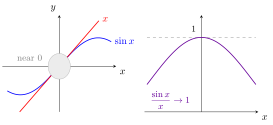
Near the graphs of and almost coincide, and the ratio tends to , so as . The ratio is not defined at itself; only the behaviour close to matters.
The ratio is evaluated by a limit at a point for finite , or a limit at infinity for or . The extended real numbers allow these infinite approach points; the ratio itself still tends to the finite number 1.
Many equivalences come from derivatives: if and , then as , because the ratio is the difference quotient of divided by . This gives and as .
Two slips are common. First, does not mean that : as although the difference tends to , while as the difference tends to but . Second, equivalent functions may be substituted in products and quotients, but not in sums: replacing by in gives , whereas in fact as . Math III refines this comparison of sizes with the big- and little- notations.
Key Results
- Asymptotic equivalence is symmetric (i.e., ) and transitive (i.e., ).
-
Operations that preserve equivalence. Assume and as Whenever the expressions are defined,
- as
- as
- for every as
- if and both tend to or both tend to then
-
Addition and subtraction require extra care, because leading terms may cancel.
- Equivalent functions may therefore be substituted for one another in limits involving products or quotients.
Examples
- as
- as
Prerequisites
Related Concepts
- Big- and Little- Notations
- Division and Quotient
- Indeterminate Form
- Limit Laws for Functions
- Squeeze Theorem for Functions
Sources
- Math I: Calculus · Lecture 8
Aliases: asymptotically equivalent functions, asymptotically equivalent Keywords: puppy rule Symbols: element of, infinity, real numbers
Last updated: 20 October 2026 03:02
Asymptotic EquivalenceLimit at a PointLimit at InfinityExtended Real NumberBig-O and Little-o NotationsDivision and QuotientIndeterminate FormLimit Laws for FunctionsSqueeze Theorem for Functions