Alternating Series
Definition
A series is called an alternating series if its terms change sign alternately. One standard form, starting with a positive term, is
where for every The negative of a series of this form is also alternating.
Interpretation
An alternating series is a series whose terms switch sign at every step, with all . Consecutive terms partly cancel, so the partial sums move back and forth instead of growing monotonically.
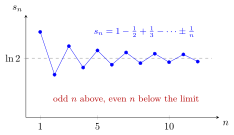
The figure shows the partial sums of for . They start at and ; after that the odd-numbered sums stay above and the even-numbered sums below the limit , closing in from both sides, with and .
In the definition, carries the sign and the size of each term. A series that starts with a negative term, , is alternating too: it is times a series of the form above. The sign pattern alone does not give convergence: is alternating and diverges. The alternating series test adds the condition that decreases to .
An alternating series can converge although diverges: the alternating harmonic series in the figure converges, while the harmonic series diverges. A geometric series with a positive first term and a negative ratio is alternating, which is why, for , its partial sums approach the limit from alternate sides.
Key Results
- Alternation of signs may produce convergence through cancellation, even when the corresponding series of absolute values diverges.
Examples
Prerequisites
Related Concepts
Sources
- Math I: Calculus · Lecture 10
Symbols: infinity, sum
Last updated: 27 October 2026 11:52
Alternating SeriesAlternating Series TestInfinite SeriesHarmonic SeriesComparison Test for Series