Union of Sets
Definition
Given two sets and the union of and is a set whose elements consist of all the elements which belong to or or both,
Interpretation
The union of sets combines elements from multiple collections. The "or" in the definition is inclusive: an element that lies in both sets belongs to the union, and it appears there only once. Union is the set version of the logical "or", just as intersection is the set version of "and".
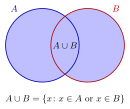
The whole area covered by either disc is shaded. The lens in the middle lies in both and , and it belongs to the union once, not twice. Each disc lies inside the shaded region, so and . If , the union adds nothing new: if and only if .
A common slip is to count elements as . This holds only for disjoint finite sets; in general the overlap is counted twice and must be subtracted once, . For this gives .
Key Results
- Elements belong to the union if they belong to at least one set.
- Union is commutative and associative, i.e., we have and
- The union with the empty set leaves a set unchanged.
Examples
Prerequisites
Related Concepts
Sources
- Math I: Calculus · Lecture 1
Aliases: set union Symbols: element of, intersection, subset, union
Last updated: 22 October 2026 19:04
Union of SetsUnion and Intersection of EventsCoverTopology and Topological SpaceUnion and Intersection of Closed SetsUnion and Intersection of Open SetsSetIntersection of SetsDifference SetSubsetComplementEmpty SetEvent