Composition of Functions
Definition
Let and be functions, and suppose that the range of is contained in the domain of We define the composition by
Interpretation
Composition of functions describes how two functions can be combined so that the output of one becomes the input of the other. The composite is read from right to left: first apply , then apply to the result.
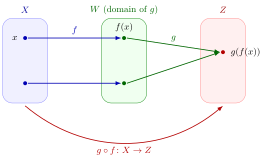
The figure follows a single point: sends to , and sends that point on to . The long arrow underneath skips the middle step and is the composite . Both arrows out of end at the same point of , which is allowed: neither nor has to be injective.
The condition that the range of lies in the domain of makes meaningful for every . With on and , the composite only makes sense for , so must first be taken on . Order matters as well: with and , but , and at the first is while the second is . A bijection composed with its inverse gives the identity function.
A common slip is to read as the product . In the second Example , whereas . Later, the chain rule gives the derivative of a composite.
Key Results
- The composition is defined when every output of lies in the domain of that is, when the range of is contained in the domain of
- The actual condition is , not equality of the declared middle sets . Self-composition on all of requires .
- Order matters: in general, and are different, and one may be defined even when the other is not.
- Composition preserves many structural properties, such as continuity and differentiability, under suitable conditions.
Examples
- If and then
- If and then
Prerequisites
Related Concepts
- Bijection and Inverse Function
- Identity Function
- Product of Linear Maps
- Function of a Random Variable
- Transformation of a Continuous Random Variable
Sources
- Math I: Calculus · Lecture 4
Aliases: function composition, composite function Symbols: element of, infinity, pi, real numbers, square root, subset
Last updated: 27 October 2026 11:52
Composition of FunctionsChain RuleLeft and Right InversesMultivariable Chain RuleFunctionDomainRange and ImageBijection and Inverse FunctionIdentity FunctionProduct of Linear MapsFunction of a Random VariableTransformation of a Continuous Random Variable