Alternating Series Test
Proposition
(Leibniz test.) An alternating series converges if is nonincreasing and
Interpretation
The alternating series test, or Leibniz test, gives a simple sufficient condition for an alternating series to converge: the sizes of the terms decrease to . The partial sums then swing back and forth around the sum with shrinking swings, and settle.
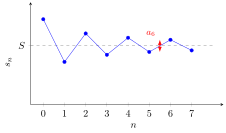
The partial sums jump across the limit in ever smaller steps. Because no step is longer than the one before, always lies between and , so the error after stopping at is at most the next step: . The figure marks the step from to .
Both conditions on are needed. If , the terms do not tend to and the series diverges, as shows. If but not monotonically, the swings can be unbalanced: the sizes give pairs with sum , and the series diverges. Monotonicity is only needed from some index on, because finitely many terms do not affect convergence. The test is sufficient, not necessary.
The error bound makes the test practical: the sum of the first terms of is within of the sum of the series. The test also covers series that converge only thanks to the signs: the alternating harmonic series converges, while the harmonic series of its absolute values diverges, so the comparison test, which needs nonnegative terms, cannot be used for it.
Key Results
- An alternating series may converge even if the series of absolute values diverges.
- The test requires both monotonicity and convergence to zero.
Examples
- converges.
- does not converge.
Prerequisites
Related Concepts
Sources
- Math I: Calculus · Lecture 10
Aliases: Leibniz test, Leibniz criterion, Leibniz's alternating series test Symbols: infinity, sum
Last updated: 20 October 2026 03:02
Alternating Series TestAlternating SeriesMonotone SequenceComparison Test for SeriesInfinite Series