Riemann Integral
Definition
Let be a bounded function. We say that is Riemann integrable on if there exists such that, for every there exists such that every partition with mesh and every choice of tags satisfy
The number is the Riemann integral of denoted by
Interpretation
The Riemann integral makes the area under a graph precise as the one number that all Riemann sums approach once the partition is fine enough. Wherever the tags are placed, once the mesh is below every tagged sum lies within of .
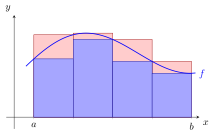
The figure uses on , split into four intervals of width . The red rectangles take the supremum of on each piece as height and give the upper sum ; the blue rectangles take the infimum and give the lower sum . Every tagged sum on this partition lies between the two. If refining the partition makes the red excess above the blue rectangles arbitrarily small, all tagged sums are squeezed to the same number, which is the equivalent criterion in the Key Results.
The words "every choice of tags" rule out functions such as the Dirichlet function on : on every partition, rational tags give the Riemann sum and irrational tags give , so no single can work. Boundedness is needed because, for an unbounded , every partition has a piece on which is unbounded, and a tag there makes the Riemann sum as large in absolute value as one likes.
A common slip is to think that only continuous functions are integrable: monotone and piecewise constant functions with jumps are integrable too.
The number is written as the definite integral . Later, the fundamental theorem of calculus evaluates it without limits of sums, and improper integrals extend it to unbounded functions and intervals.
Key Results
- Equivalent criterion. A bounded is Riemann integrable if and only if, for every there is a partition with the upper and lower sums then squeeze the same integral as the partition is refined.
- Informally, along the regular subdivisions into equal pieces.
- The integral value is independent of the choice of tags
- Boundedness of the function is essential for integrability.
- Every constant function is Riemann integrable with and so is every piecewise constant function on a bounded interval.
Examples
- Continuous functions on a closed bounded interval are Riemann integrable.
- Monotone functions on a closed bounded interval are Riemann integrable.
- The Dirichlet function is bounded on but not Riemann integrable: every partition has
Prerequisites
Related Concepts
Sources
- Math I: Calculus · Lecture 10
Aliases: Riemann integrable, Riemann integrability Symbols: delta, element of, epsilon, infinity, integral, real numbers, sum
Last updated: 27 October 2026 11:52
Riemann IntegralDefinite IntegralFundamental Theorem of Calculus Part 1Integration by Substitution Type 1Integration by Substitution Type 2Probability Density FunctionRiemann SumDirichlet FunctionAntiderivativeIntegrandPartition of an Interval