Integral Test for Convergence
Proposition
Let be continuous, nonnegative, and nonincreasing. Then
converge or diverge together. Moreover, the sequence
converges.
Interpretation
The integral test compares a series of nonnegative terms with an improper integral of the same shape. The terms are the heights of rectangles of width along the graph of , so the partial sums and the integrals grow together, and one stays bounded if and only if the other does.
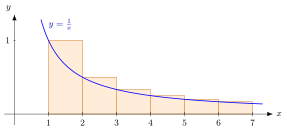
For the rectangles have areas and lie above the graph, so , which tends to .
The rectangles give a precise comparison. Since is nonincreasing, for ; integrating over and adding gives
Because , both the partial sums and the integrals increase with , so each converges if and only if it is bounded, and the inequalities transfer boundedness in both directions. Without monotonicity the test fails: is continuous and nonnegative with for every , so the series converges, while diverges.
The test is how the -series are settled from the -test. The second statement says more: for the differences converge, with limit about , so the partial sums of the harmonic series grow like .
A common slip is to take the integral as the value of the series. The series and converge together, but the sum is while the integral is .
Key Results
- The test applies only to continuous, nonnegative, nonincreasing functions.
- Convergence of the improper integral implies convergence of the series.
- Divergence of the improper integral implies divergence of the series.
- The test provides a comparison, not the value of the sum.
Examples
- The series converges because converges.
- The series diverges because diverges.
Prerequisites
Related Concepts
Sources
- Math I: Calculus · Lecture 12
Aliases: integral test, Cauchy integral test, Maclaurin-Cauchy test Symbols: element of, infinity, integral, pi, real numbers, sum
Last updated: 22 October 2026 19:04
Integral Test for Convergencep-seriesMonotone FunctionContinuityImproper IntegralInfinite SeriesComparison Test for SeriesHarmonic Seriesp-testComparison Test for Improper Integrals