Inverse Function Theorem
Theorem
Let and be open intervals in , and let be an invertible function, with inverse Suppose that and are such that or equivalently, If is differentiable at and is continuous at then is differentiable at and
Interpretation
The inverse function theorem says when the inverse of a differentiable function is again differentiable, and how to find its derivative without a formula for : the slope of at is the reciprocal of the slope of at the matching point .
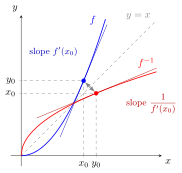
The graph of is the graph of reflected in the line , and the reflection swaps rise and run. Here and : the tangent to at has slope , and its mirror image, the tangent to at , has slope , which is indeed the derivative of at .
Each hypothesis has a role. If , the tangent of is horizontal and its mirror image is vertical, so has no derivative at : has , and the cube root has a vertical tangent at . Continuity of at makes as , so that difference quotients of are reciprocals of difference quotients of near . When is continuous on the whole interval , it is strictly monotone, and then is automatically continuous.
The formula is easy to remember through the chain rule: differentiating gives . This calculation assumes that exists; the theorem guarantees it. A common slip is to evaluate at the wrong point: is with , not . For this gives , not . Math IV extends the theorem to functions of several variables in the multivariable inverse function theorem.
Key Results
- If is nonzero throughout an open interval, then is strictly monotone there and hence invertible onto its range. The theorem itself assumes that is invertible and only concerns the differentiability of
- Differentiability of the inverse depends on continuity assumptions.
- The derivative of the inverse is determined by the reciprocal of the original derivative.
Examples
- If then the derivative of the inverse is at
- The derivative at is the reciprocal of the derivative of at
Prerequisites
Related Concepts
Sources
- Math I: Calculus · Lecture 7
Aliases: inverse function rule, derivative of the inverse function Symbols: element of, real numbers, square root
Last updated: 20 October 2026 03:02
Inverse Function TheoremTransformation of a Continuous Random VariableBijection and Inverse FunctionContinuityDerivative and DifferentiabilityChain RuleInverse Trigonometric FunctionsLogarithm and Logarithmic Function