Domain
Definition
The domain of a function is its specified set of allowed inputs. We call an input the independent variable.
Interpretation
The domain specifies which input values are allowed for a function. It is part of the function itself: the same formula on two different domains gives two different functions.
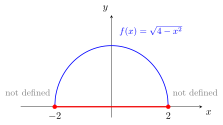
The red interval is the domain of the function in the figure: it contains the inputs where is defined and is the projection of the graph onto the -axis. For the number is negative, so its square root is not defined.
When a function is given only by a formula, the usual convention is to take as domain the largest set of real numbers on which the formula makes sense. The usual obstacles are division by zero, even roots of negative numbers and logarithms of numbers that are not positive. The domain also has to be checked when functions are combined: a composition needs the values of to lie in the domain of , and choosing a smaller domain can make a function invertible, as is from to .
A common slip is to mix up the domain, which collects inputs, with the range, which collects outputs. For the domain is , but the range is .
Key Results
- A function is only defined on its domain.
- Restrictions on the domain may arise from algebraic or analytical conditions.
- Different domains lead to different functions, even if formulas coincide.
Examples
- The function has domain
- The function has domain
- The function has domain whereas an even root such as requires a nonnegative input.
Prerequisites
Related Concepts
- Codomain
- Range and Image
- Graph of a Function
- Inverse Trigonometric Functions
- -th Root
- Random Variable
Sources
- Math I: Calculus · Lecture 4
Aliases: domain of definition Symbols: infinity, real numbers, square root
Last updated: 20 October 2026 03:02
DomainComposition of FunctionsInjective FunctionSingularityImage and Preimage of a SetFunctionCodomainRange and ImageGraph of a FunctionInverse Trigonometric Functionsn-th RootRandom Variable