Monotone Sequence
Definition
A sequence is (monotonically) increasing or nondecreasing if for all and it is (monotonically) decreasing or nonincreasing if for all
A sequence is strictly increasing if for all and it is strictly decreasing if for all
Interpretation
A monotone sequence moves in one direction only: an increasing sequence never steps down, and a decreasing sequence never steps up. Equal consecutive terms are allowed unless the word "strictly" is added.
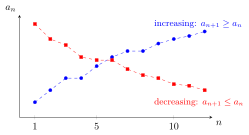
Neither sequence in the figure is strictly monotone. The blue increasing sequence has two flat steps, and , and the red decreasing sequence has one, . A single step in the wrong direction, however small, would make a sequence non-monotone.
The definition compares consecutive terms only. Applying transitivity of the inequalities repeatedly gives for all in the increasing case. To check monotonicity, one usually studies the sign of : for the difference is , so the sequence is strictly increasing. A constant sequence is both increasing and decreasing.
Monotonicity is the hypothesis that drives the monotone convergence theorem: an increasing sequence converges if and only if it is bounded above. The indices of a subsequence form a strictly increasing sequence. The same words return for functions as monotone functions.
A common slip is to assume that a convergent sequence is monotone. The sequence converges to but alternates in sign, so it is neither increasing nor decreasing.
Key Results
- Monotone sequences may converge or diverge.
- Bounded monotone sequences are convergent.
Examples
- is decreasing and convergent.
- is increasing and divergent.
Prerequisites
Related Concepts
Sources
- Math I: Calculus · Lecture 3
Aliases: monotonic sequence Keywords: increasing sequence, decreasing sequence, nondecreasing sequence, nonincreasing sequence Symbols: infinity
Last updated: 20 October 2026 03:02
Monotone SequenceAlternating Series TestMonotone Convergence TheoremSubsequenceInequalityBounded SequenceLimit of a SequenceMonotone Function