Monomial and Power Function
Definition
The function is called a monomial if the exponent is a natural number or a power function if is allowed to be a real number. The real number is the coefficient. For a nonzero monomial (), is its degree. The zero function () has no degree under this convention, since every natural exponent gives the same zero monomial.
Interpretation
Monomials and power functions are the simplest building blocks of algebraic growth: one coefficient times one power of . The exponent decides the shape of the graph, while the coefficient only stretches it vertically or, when , also reflects it in the -axis.
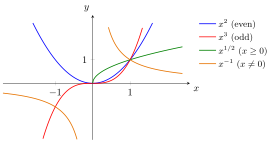
The figure shows four standard shapes, all passing through because . The even power is symmetric about the -axis and the odd power is symmetric about the origin. The root is drawn only for , and has two branches because it is not defined at .
The exponent also fixes the domain. For a natural number , is defined on all of ; an even gives and an odd gives . A negative integer exponent means , so is excluded, while for a general real exponent is defined for , as described under exponentiation. Comparing exponents depends on where lies: on a larger exponent gives a larger value, but on the order is reversed, for example .
A common slip is to confuse a power function with an exponential function. In the variable is the base and the exponent is fixed; in the base is fixed and the variable is the exponent. Monomials are the building blocks of polynomials, which are finite sums of them.
Key Results
- The coefficient controls scaling, while the exponent controls growth behaviour.
- Power functions with a negative exponent have a singularity at (for example ). For a non-integer exponent is in general defined only for (or when ).
Examples
- is a monomial of degree
- is a power function with a singularity at
Prerequisites
Related Concepts
Sources
- Math I: Calculus · Lecture 4
Aliases: power function Symbols: infinity, real numbers, square root
Last updated: 27 October 2026 11:52
Monomial and Power Functionp-seriesPolynomialMonomial on R^nPower SeriesFunctionExponentiation and PowerExponential Functionn-th Root