Supremum
Definition
Let be nonempty and bounded above. The supremum of is its least upper bound, denoted by
Interpretation
The supremum of a set is its least upper bound: the smallest number that no element of the set exceeds. It describes where a set ends on the right even when no element sits there, that is, even when the set has no maximum.
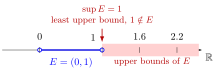
For , every number from onwards is an upper bound, such as the marked and ; together they form the shaded ray . Its left end is the least upper bound, so , although .
Being the least upper bound has two parts: is an upper bound, and no smaller number is one. The second part is usually checked with an : for every some satisfies . For and , the element lies above .
The existence of suprema is the completeness of the real numbers, and several results depend on it: the monotone convergence theorem identifies its limit as a supremum, and the -th root is defined as one. The mirror notion is the infimum.
A common slip is to treat as the largest element of . It is the largest element exactly when it belongs to , and then ; for it does not belong to the set.
Key Results
- A supremum need not belong to the set.
- By the least-upper-bound property (see real number) of every nonempty subset of that is bounded above has a unique supremum.
- In the extended real numbers, one uses the conventions for a nonempty set with no upper bound and neither nor is a real number.
Examples
- The supremum of is
- The supremum of is
Prerequisites
Related Concepts
Sources
- Math I: Calculus · Lecture 3
Aliases: least upper bound, sup Symbols: element of, epsilon, infinity, real numbers, subset
Last updated: 20 October 2026 03:02
SupremumMonotone Convergence Theoremn-th RootLimit Superior and Limit InferiorUniform NormUpper BoundInfimumMaximum of a SetBounded SetBounded FunctionExponentiation and PowerReal Number