Inflection Point
Definition
Let be defined on an interval, and let be an interior point of it. The graph point is an inflection point if the graph changes from convex to concave, or from concave to convex, at
Interpretation
An inflection point marks a change in the curvature of a function: on one side of it the graph is convex, on the other side concave. It is a statement about the shape on both sides, not about a single value of a derivative.
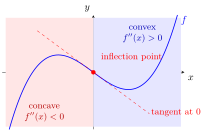
For , the second derivative is negative to the left of and positive to the right, so the graph changes from concave to convex at the inflection point . The tangent there, , crosses the graph: on the concave side the graph lies below the tangent, on the convex side above it.
The point lies on the graph of the function, so its coordinates are . For a differentiable , convex means that is increasing and concave that is decreasing, so at an inflection point switches from decreasing to increasing or back: is a local extremum of . In the figure, has its minimum at .
Two slips go in opposite directions. The equation is not enough: has but is convex on both sides of . And an inflection point need not satisfy , because need not exist: is concave on and convex on , but has no second derivative at . So the candidates are the zeros of together with the points where does not exist, and each candidate must be checked for a change of sign of .
Key Results
- If is twice differentiable at an inflection point then
- The equation alone is not sufficient: the convexity must actually change at
Examples
- The function has an inflection point at
- The function has no inflection point at
Prerequisites
Related Concepts
Sources
- Math I: Calculus · Lecture 9
Aliases: point of inflection, inflexion point Symbols: infinity
Last updated: 20 October 2026 03:02
Inflection PointConvexity and ConcavityGraph of a FunctionHigher-Order DerivativeLocal Extremum