Comparison Test for Series
Proposition
Suppose we have two series and with for all and for all Then:
- If is convergent, then is also convergent.
- If is divergent, then is also divergent.
Interpretation
The comparison test decides the convergence of a series with nonnegative terms by comparing it, term by term, with a series whose behaviour is known: a series below a convergent one converges, and a series above a divergent one diverges.
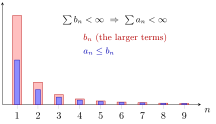
The bars show and the smaller terms for ; for example, . Since for every , each partial sum of is at most the corresponding partial sum of , and hence at most .
That bound is the whole proof: because , the partial sums of increase, and an increasing sequence that is bounded above converges by the monotone convergence theorem. This is why nonnegativity is needed: , yet converges and diverges. The inequality only needs to hold from some index on, because finitely many terms do not affect convergence.
A common slip is to compare in the wrong direction. A series below a divergent one may converge or diverge: and converges, while and diverges. In such cases the test is silent, and a different comparison is needed. The usual benchmarks are the geometric series and the harmonic series. The same idea returns for integrals in the comparison test for improper integrals.
Key Results
- Comparison requires all terms to be nonnegative.
- A series can be shown convergent by comparison with a larger convergent series.
- Divergence can be shown by comparison with a smaller divergent series.
Examples
- converges, so also converges.
- Since diverges, so does
Prerequisites
Related Concepts
- Alternating Series Test
- -series
- Harmonic Series
- Integral Test for Convergence
- Squeeze Theorem for Sequences
- Comparison Test for Improper Integrals
Sources
- Math I: Calculus · Lecture 10
Aliases: direct comparison test Symbols: infinity, square root, sum
Last updated: 20 October 2026 03:02
Comparison Test for SeriesInfinite SeriesAlternating Series Testp-seriesHarmonic SeriesIntegral Test for ConvergenceSqueeze Theorem for SequencesComparison Test for Improper Integrals