Logarithm and Logarithmic Function
Definition
The logarithm of a positive real number with respect to base ( and ) is the exponent to which must be raised to get In other words, the logarithm of to base is the solution to the equation This logarithm is denoted by The function on is called the logarithmic function of to base It is the inverse of the exponential function with base The logarithm with base is called the natural logarithm, denoted Without a base, usually means in analysis texts but in some other texts, so it is safest to state the base.
Interpretation
The logarithm answers the question "which power?": is the exponent with . Logarithmic functions therefore measure exponents and invert exponential growth, and they transform multiplicative relationships into additive ones.
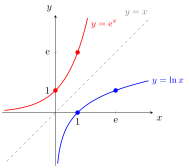
undoes : the points , on mirror to , on , so and . The reflection in the dashed line swaps inputs and outputs, so the logarithm accepts only positive inputs but can return any real number.
The restrictions in the definition come from the exponential function. For with , every value is positive and every positive number is reached exactly once, so exists only for and is then unique. The base is excluded because for every : the equation has no solution for and infinitely many for . For the logarithm is negative on , zero at and positive beyond.
The product law is the reason logarithms turn growth factors into increments: multiplying by adds exactly to . Different bases differ only by a constant factor, , so the natural logarithm, with base Euler's number, is enough in practice.
A common slip is to apply the product law to sums: is in general not . For instance, , whereas .
Key Results
- Logarithms are defined only for positive inputs.
- Logarithmic functions are strictly monotone.
- We have the following results:
- Product law:
- Quotient law:
- Power law:
Examples
Prerequisites
Related Concepts
Sources
- Math I: Calculus · Lecture 4
Aliases: logarithm, logarithmic function Keywords: natural logarithm, ln, log Symbols: alpha, real numbers
Last updated: 20 October 2026 03:02
Logarithm and Logarithmic FunctionHalf-LifeInterest and DiscountingExponential FunctionBijection and Inverse FunctionInverse Function Theorem