Differential
Definition
Let be a function differentiable at a point The differential of at is defined as
where denotes the differential of the independent variable
Interpretation
The differential gives the linear part of the change of near a point: for an increment of the input, is the change that the tangent line predicts. It is the bridge between the derivative, a single number, and linear approximation, a statement about changes.
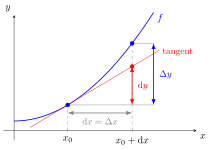
is the rise of the tangent; is the rise of itself. Here the curve bends upwards, so is larger than . For small the two are close: the gap is small even compared with .
At a fixed point , the differential is a linear function of the increment: doubling doubles . Dividing by gives back , which is one way to read the Leibniz notation for the derivative.
A common slip is to treat as the exact change. At a given point, and agree for every increment only when is a linear function ; otherwise is an approximation whose quality depends on how small is.
The notation returns later in integration by substitution, where is replaced by for .
Key Results
- The differential depends linearly on the increment
- Differentiability guarantees the existence of a differential.
-
Linear approximation. If is differentiable at then for close to its tangent line gives
This tangent-line (linear) approximation is the form in which the differential is used in Math I: Calculus.
Examples
- For
- For
- For we have so while the exact value is
Prerequisites
Related Concepts
Sources
- Math I: Calculus · Lecture 6
Aliases: differential of a function Keywords: linear approximation Symbols: delta
Last updated: 20 October 2026 03:02
DifferentialIntegration by PartsIntegration by Substitution Type 1Integration by Substitution Type 2Derivative and DifferentiabilityDefinite IntegralIndefinite Integral