Bijection and Inverse Function
Definition
A function is invertible (or bijective) if it is both injective and surjective. If is a bijection, then for every there is exactly one such that (there is at least one because of surjectivity, and at most one because of injectivity). This value of is denoted thus is a function from to We call the inverse of
Interpretation
A bijection establishes a perfect correspondence between two sets: every element of the codomain is paired with exactly one element of the domain. Invertibility formalizes the idea that such a function can be run backwards without ambiguity: from each output one recovers the unique input that produced it.
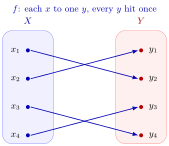
In the figure every point of receives exactly one arrow; for instance , so . Reversing every arrow gives the inverse . It satisfies for and for .
Each half of the definition is needed for the reversed arrows to form a function. If is not injective, some receives two arrows, and would have two values. If is not surjective, some receives no arrow, and is undefined. Whether is a bijection therefore depends on the chosen domain and codomain, not only on the formula: is not a bijection from to , but it is one from to , with inverse , the -th root for . In the same way the logarithm with base is the inverse of the exponential function for , .
A common slip is to read as the reciprocal . For the inverse gives , while .
Key Results
- A function admits an inverse if and only if it is bijective.
- The inverse of a bijection is itself a bijection.
- Composition with an inverse recovers the identity function on both domain and codomain.
Examples
- The function , , is bijective and has inverse
- The function , , is not bijective and therefore not invertible.
Prerequisites
Related Concepts
- Identity Function
- Composition of Functions
- Function
- Image and Preimage of a Set
- Range and Image
- Quantile Function
Sources
- Math I: Calculus · Lecture 4
Aliases: bijective function, bijection, one-to-one correspondence, invertible function, invertible, bijective, inverse mapping, bijective map, invertibility, bijectivity, inverse function, one to one correspondence Keywords: inverse function, one-to-one and onto, finding an inverse, conditions for invertibility, when is a function invertible, proving a function is bijective, prove injective and surjective Symbols: element of, infinity, real numbers, square root
Last updated: 27 October 2026 11:52
Bijection and Inverse FunctionInverse Function TheoremInverse Trigonometric FunctionsLogarithm and Logarithmic FunctionCantor's Diagonal ArgumentCardinalityPermutationInjective FunctionSurjective FunctionIdentity FunctionComposition of FunctionsFunctionImage and Preimage of a SetRange and ImageQuantile Function