Limit at Infinity
Definition
Let and let be a function. Assume there exists such that We say that converges to as and we write if for every there exists such that
Similarly, assume there exists such that We say that converges to as and we write if for every there exists such that
Interpretation
A limit at infinity describes how a function behaves as the input grows without bound: as means that stays as close to as we like once is large enough. It formalizes long-term or asymptotic behaviour: the line is then a horizontal asymptote of the graph.
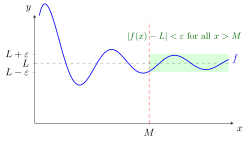
The shaded band is the strip to the right of the threshold , and the definition asks that the graph stays inside it for all . The damped oscillation keeps crossing the dashed line : need not approach monotonically or from one side, only the distance has to become small. A narrower band usually needs a larger .
The bound takes over the role of in the limit at a point: is given first, and may depend on it. The assumption makes sure that every belongs to the domain, so the condition says something about for all large inputs.
The definition is the continuous counterpart of the limit of a sequence, with in place of . If as , then also as . The converse fails: for every integer , but has no limit as . Limits at infinity return later, for example in improper integrals over unbounded intervals.
Key Results
- Limits at infinity describe behaviour far from any finite region.
- A function may have different limits at and
- Limits at infinity may also be infinite: means that for every there exists such that the cases with are analogous.
Examples
Prerequisites
Related Concepts
- Divergence to Infinity
- Extended Real Number
- Infinity
- Limit of a Sequence
- Comparison Test for Improper Integrals
- Cumulative Distribution Function
Sources
- Math I: Calculus · Lecture 5
Aliases: limit of a function at infinity Keywords: function limit Symbols: delta, element of, epsilon, infinity, pi, real numbers, subset
Last updated: 20 October 2026 03:02
Limit at InfinityAsymptotic EquivalenceHorizontal AsymptoteImproper IntegralIndeterminate FormSqueeze Theorem for FunctionsBig-O and Little-o NotationsStability of an EquilibriumFunctionDivergence to InfinityExtended Real NumberInfinityLimit of a SequenceComparison Test for Improper IntegralsCumulative Distribution Function