Horizontal Asymptote
Definition
Let be a real number. The line is called a horizontal asymptote of the curve if either
Interpretation
A horizontal asymptote describes the long-term behaviour of a function as the input grows large in magnitude.
It indicates that the function approaches a constant value.
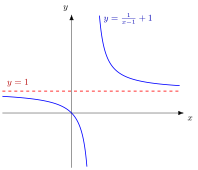
The figure shows . Here as and as : the line is a horizontal asymptote.
A limit at infinity describes how the outputs behave far along the input axis. In the graph, this says that the vertical distance from the curve to the horizontal line tends to zero, without requiring the curve to stay on one side.
Key Results
- A function may have different horizontal asymptotes as and
- Horizontal asymptotes may or may not be attained by the function.
Examples
- The function has horizontal asymptote
- The function has two different horizontal asymptotes: as and as The arctangent , from a later lecture, behaves in the same way with
Prerequisites
Related Concepts
Sources
- Math I: Calculus · Lecture 5
Symbols: infinity, pi, square root
Last updated: 27 October 2026 11:52
Horizontal AsymptoteGraph of a FunctionLimit at InfinityVertical AsymptoteRational Function